|
The Most Trusted Man in America:
That’s the Way it Was By Sanford Socolow |
|
|
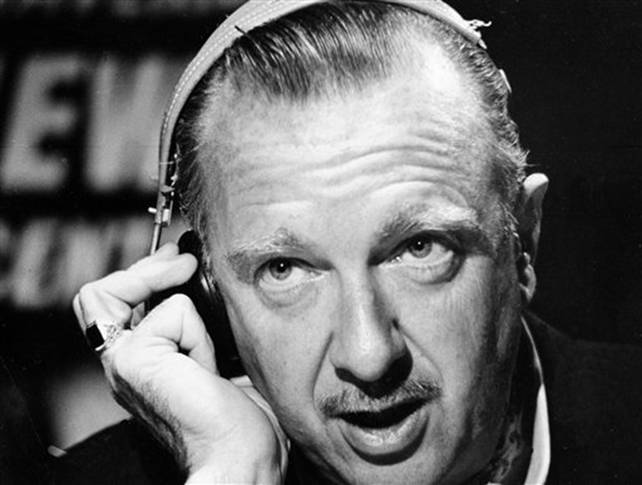
CBS News Walter Cronkige, iconic CBS anchorman and managing editor of the
“CBS Evening News,” who presided for more than a generation over the
transformative and turbulent events of American history with grace and
reassurance. |
|
|
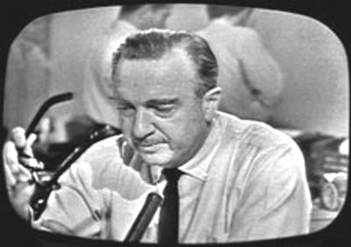
CBS News Etched deeply into our
memories, Walter Cronkite announcing the death of President John F. Kennedy
on November 22, 1963. |
AP Walter Cronkite’s interview with President John F. Kennedy in
September of 1963, two months before his assassination. |
|
By Sanford Socolow I
am continually amazed at the recognition and praise for Walter Cronkite since
it has been 28 years since he left his dominant position as most famous news
personality except, perhaps, for Edward Murrow. That means that most Americans alive today
never experienced him, except for occasional cameo appearances after he left
the daily television scene. When he
stepped down as anchorman/reporter, his ratings were higher than the combined ratings of the three network
news broadcasts and all internet and cable newscasts at the same evening
hour. The
Most Trusted Man in America always thought of himself as a basic wire service
reporter. He had a history with United
Press before he joined CBS News, at a time when CBS News required that new
hires have at least five years of writing or reporting experience. The theory behind that requirement: CBS
News could teach the techniques of broadcasting but could not duplicate the
reportorial experience necessary. Fans
of The Most Trusted Man in America usually want to know “what was he really
like?” The disappointing answer is
that he was really like he was on television and maybe that is why he was
trusted and appreciated. By that I
mean “Uncle Walter,” off screen, wasn’t the opposite of his benign
image. Of course, he could be a
demanding taskmaster and there were many tough talks between him and his
staff. Once,
when I was Executive Producer of The Evening News, I was invited to a
screening of “The China Syndrome,” a
movie with an uncanny echo of the Three Mile Island Nuclear accident, in which
radioactivity was feared all over central Pennsylvania. The similarities, I thought, were dramatic,
since the movie was two years in the making.
Walter was also invited to the screening but skipped it because of a
schedule conflict. In his office, I
explained my amazement, and told him I thought we should do a sidebar story
about this movie/real life coincidence, since the Three Mile Accident was
dominating news coverage. Without
slipping a beat, he shouted at me, “I am not in the business of selling
tickets to some damned movie!”
Contrast that to what we see on our video newscasts today. When it was suggested he
become anchorman of The Evening News, he demanded the title, “Managing
Editor.” He told me it was a deal
breaker, as far as he was concerned, unless he got it. The title gave him (with management
agreement) final say on what stories The Evening News would carry and even
how they were presented. In my
memory, there never was any sort of important disagreement between him and
staff. Remember, when he started, the
staff and the Managing Editor had similar backgrounds and outlooks about what
a daily newscast should be. Now, of course, all
anchorpersons, network and local, have the title. I often wonder if they understand what the
title represented when it was adopted from newspapers to television. When Cronkite, a veteran
print reporter, first appeared on the then 15 minute CBS Evening News, he
ended the newscast telling viewers (paraphrase): “Those are the news
highlights. Be sure to read your daily
newspaper for the details.” It raised a storm with
corporate executives, who saw it as an invitation for viewers (and
subsequently, advertisers) to leave their television sets and go to
newspapers for their news. After lots
of tough talk, back and forth, Walter agreed to back away from that sign
off. That’s how his famous sign off,
“And that’s the way it is,” was born.
Even that sign off caused a tempest between Walter and Dick Salant,
then president of CBS News, who insisted we were NOT telling the audience
“The Way It Is,” because we couldn’t do it in an eight minute (of a 15 minute
broadcast) news hole. Salant was
persuaded to go along with it. Walter is father of three
and grandfather of four. His third
grandson, Walter Leland Cronkite IV, is an intern in the CBS News Washington
Bureau, where Walter (“Jr,” his father was a dentist) started his CBS News
career. Anchorman Cronkite’s first
assignment, after being hired by Edward R. Murrow, then the corporate
executive in charge of CBS News, was anchor (the title had not yet been
applied) of the 11 p.m. newscast at WTOP-TV in Washington. The station was then owned by CBS, and
Murrow had responsibility for the various local, as well as network, news
operations. The Korean War was in full
fury and Walter decided to do a chalk talk about the daily battle lines. This
was possible since it was perhaps the last “conventional” war (as opposed to
guerilla wars). Each night they would stretch a heavy paper map on a
stretcher with broad outlines of the current situation. As Walter described the day’s actions, a
stagehand, invisible behind the paper screen, would touch a lighted cigar to
the appropriate spot. This lasted
until the fire department noticed, and shut it down. This was an era in which television news
was so new (and still so junior to radio news) that production techniques were being invented
on an ad hoc basis. Back to the question
about Walter’s real persona, he had a ribald sense of humor. At staff Christmas parties at his home, he
would dance a mock strip tease, based on his memories of a famous 1930s
mid-Western strip tease artiste, Hinda Wasser. Walter had a crush on Ms Wasser. He mimicked her body movements to an
amazing degree. He played, or tried to
play, a clarinet, not very well. He
was an avid dancer. Dining with him
and Betsy, his beloved wife, was always a chore, as he became more
famous. Other patrons without
restraint would come to his table and ask for conversation or an
autograph. Walter was unfailingly
polite and accommodating. But more
disruptive to his dinner mates, was his tendency to engage the intruder in
conversation, asking about background
and geography and showing genuine interest beyond the call of politeness. And, finally, there was
his dedication to the craft and his belief in its importance if democracy was
to work. After he retired from The
Evening News, he “came out of the closet,” as he put it, and showed his
liberal colors. He was dismayed that after the September 11th tragedy,
the White House had a meeting with
television news executives, who agreed they would not broadcast the
Osama bin Laden videos which were being widely distributed elsewhere at the
time. On the other hand, he was
dismayed (for many other reasons also) when the Democratic Party
establishment pressed him to run for the Senate in the 1960s, but never once
asked him what his position was on various public issues of the day. Chances for the emergence
of another such dominating figure in the news universe are low. The proliferation of news outlets and
subsequent fracturing of the audience make it more difficult, maybe
impossible. That’s the way it is. |
|