|
Ireland Wept for Her Son By Pete Hamill |
|
|
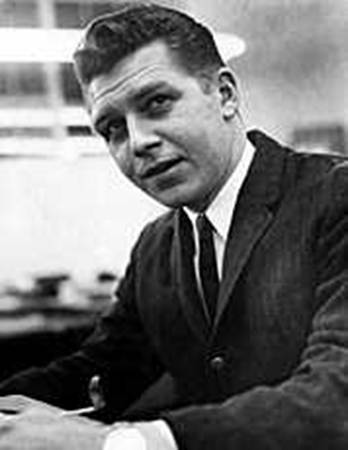
The young Pete Hamill. |
Ireland wept for its son. |
|
By Pete Hamill That
day I was in Ireland, in the dark hard Northern city of Belfast,
with the fine wire of the winter rain driving in sheets
from the roiled sea. Along the Falls Road, women in shawls bent
into the punishing November wind, like damp mobile bundles. The men stood in
the beery warmth of the BeeHive pub, or the Rock Bar, their faces
raw, caps pulled down hard, smoking pipes, drinking stout, watching their
women in the rain-slick streets. Once a small boy in a yellow raincoat darted
from a candy store, pulling an empty red wagon. I
don’t know where he was going, or why he had that wagon, or where he is this
very moment. But he became the kind of small detail we all remembered
later. For me, it was his wagon, the ruin of my father’s
face and, of course, the rain. For my father,
it was the first time in 31 years he had been home to the city
of his youth, and to understand the rest of the
day, I must tell you something about Billy Hamill. He’s a short round guy
with a hoarse voice now, but in the old pictures he looks like a very tough
lightweight, two muscled legs jutting from soccer shorts, his face
breaking in a cocky grin. He grew up in Belfast, a Catholic in a murderously
bigoted Protestant town, and by the time he was 21 he understood that the future
must lie somewhere across a sea. Like all the exiles before or
since, he left for America. He
lived in Red Hook in Brooklyn and played soccer with St. Mary’s. Old men have
told me he was a fine soccer player. He thought he had magic legs,
he told me once, and there were great afternoons when those legs moved as if they
had brains of their own, taking him down past defenders,
driving the ball where he wanted it to go. Until one afternoon
in Brooklyn, moving rapidly, he did not see the German coming up fast from the
side, nor his leg cocked like some human hammer; but suddenly my father
was on the ground, his left leg smashed below the knee, the bones jutting
through the skin. He remembered them tearing a slat from the
fence and lying on the frozen
earth while they lashed it to his leg, and waiting two hours for an
ambulance. He
remembered lying in Kings County Hospital, the boot still tied to his
destroyed leg, listening to two detectives question a stabbed stranger across
the ward. And he remembered the next morning, the leg already poisoned by
gangrene, how they had to cut the boot off with scissors, and later, the
sound of the saw going through the bone above his knee,
and knowing that whatever might happen next a part of his
American dream was gone forever. But
my father raised seven children who love him and that November we made good
on an old vow and went to Ireland together. The old hatreds had not vanished;
but we did have some great nights of song and laughter ,and great waterfalls of beer.
He was back the country he had spent half a lifetime
singing about and he did not have to get up in the mornings if he did
not want to. It was no small thing. On
the evening of the 22nd, I was in a cousin’s home, playing with
children, the TV blaring, drinking a bit, when suddenly the sound blacked out
and an announcer came on to tell us that President Kennedy had been shot in
Dallas. A few minutes later, the announcer was back on again, the phone ringing on his desk, his
voice breaking saying that the President of the United States of
America, John Fitzgerald Kennedy, was dead. I
fled into the night to find my father. For men
like Billy Hamill, it was even more important that John Kennedy had become
President than it was for me. In its way, Kennedy’s election was a
personal matter for my old man; it meant that his children and theirs would
not be disqualified from birth from
becoming leaders of the mightiest nation on this earth. It meant
that perhaps after all, the exile and the longing and the crippled
dream of America had all worked itself out;
it was certainly no small thing now to say that you were Irish. I
found him leaving his brother’s house. He was
crying and his face looked white and ruined. We all walked
through the frail rain to the second floor lounge of the
Rock Bar. "The dirty murdering sons of bitches," he said, over and
over, as we climbed the stairs. "The dirty sons of
bitches." Behind
us, as we sat at a round table, was a long hall with a TV set at the end
showing Kennedy’s visit to Ireland a few months before,
and my father said that it might be the last time we
would see his face whole because we knew that he had been shot
in the head, and then Kennedy was at Shannon airport, telling Ireland that he
would be back in the spring. The film ended. And
then the damndest thing happened: "The Star Spangled Banner" began
to play, and every man in that bar, maybe 50 of them, stood up and faced
the TV screen and saluted. They
were saluting the leader of another country and really it was a salute to an
Irishman’s son who had made them proud, and then my father
started to sing the anthem in his hoarse voice and all of us
were crying because we knew finally he had become an American. I
don’t remember very much about the rest of that night; we all got very drunk
and went home. I remember seeing a man drive his hand into a tree, and women
sobbing dryly as they always do in Ireland. And while the fine
rain fell through the dark Irish night, my father
told me, as he tried to sleep, that he had not cried so hard since the day
long ago when he had lost his magic leg. In that moment, I loved him more
than I ever had before, and I love my father
very much. |
|
|
|
|