|
Farewell to Mac By Dennis Duggan |
|
|
The great Mike
McAlary. |
McAlary's revelations
of police torture that stunned a city. . |
|
By Dennis Duggan Mike McAlary wrote almost every one of his
columns as though he were going to be hit by a truck. That was a dictum set forth by
Murray Kempton, one of McAlary’s idols. They were as different as
night and day but they were bonded by their passion for
newspapering. I spent many days and many nights in
McAlary’s company, the days were in New York Newsday’s city room on He died on Christmas Day of cancer.
He was 41. A few months earlier in a heart-breaking scene in
the New York Daily News City Room he acknowledged the cheers of his
fellow reporters and said that he hoped he would live long enough to see his
children grow up and to be able to walk on the beach with them. Tears flowed that day and last
December 25th at Charlie Sennett, who worked with McAlary
at both the New York Post and the Daily News, recalled his days working
alongside McAlary who the Times said was "the city’s dominant tabloid
reporter of the last decade," wrote this moving tribute
to McAlary. "So Mac is gone. I’ll never forget
being a young cop reporter at the Post and the News and being able to claim
him as a friend. "I’ll never forget the
way he ran his finger down a small, black book of contacts
and told you exactly which detective to call in “I’ll never forget how
he liked to sing at Elaine’s. "I’ll never forget his
stamina." Sennett, now with the Boston Globe,
recalled being up all night at a cops’ social club in "Kriegel (Daily News sports
columnist Mark Kriegel) and I would be a mess sleeping on the floor or
the couch and Mike would be up early reading the papers and making his
calls." Best of all, says Sennett, was when
McAlary complimented you on a story. "The story rocked," he would
say. I know just how generous Mac was first
hand. I covered the trial of John
Wayne Bobbitt and his wife Lorena in a The day after the trial I got the only
interview with her at a nail salon where she worked. She did my nails as we talked and at one
point dug her little paring knife too
deep into my cuticle. "Ouch," I exclaimed. In my lead, I wrote that I was luckier
than her husband. My hotel phone rang that day. It was Mac on the phone
laughing and telling me, "That really rocked!" But it was Mac’s cop reporting that
began at New York Newsday that attracted attention. He was hired by the
newspaper’s editor Don Forst who had first hired him to work as a
high school sports reporter at the Boston Herald American in 1980. "He had the fire,"
Forst
who is now editor of the Village Voice told me. "He had passion for his
work and he had fun doing it," said Forst who
tried to convince McAlary to stay at the paper promising him that he would
become a columnist. "That was the year we brought Jimmy
Breslin over from the Daily News. Mac saw an opening at the
News and went there to become a columnist. It was a swap." I hated to see McAlary leave the paper.
He was a throwback to the earlier days of the two-fisted, hard drinking reporters of my era.
I don’t think McAlary spent a day of his life in a health club running to nowhere. He was too
busy soaking himself in the city’s brine and becoming the kind of breaking
news writer who left the rest of us with our mouths hanging open. When he left New York Newsday he wrote
in his first book "Buddy Boys," which was about police corruption
in the 77th police precinct in "To
Dennis, "It’s your
town. "They’re
your streets. "I’m just
renting. "All the
best. "Your Friend,
Mike McAlary " In writing this tribute I talked to friends
all over town including the many he made in the New York Police Department.
He forged a special and rare relationship with people in law enforcement,
many of whom are suspicious of most of us in the
press. I sat in Greg Lasak's office on the
third floor of the State Supreme Court Building on Besides Lasak, the number two man in
Queens District Attorney Richard Brown's office, there were former
Police Commissioner Ray Kelly and John Timony, now police commissioner in Abner Louima stood alongside one aisle
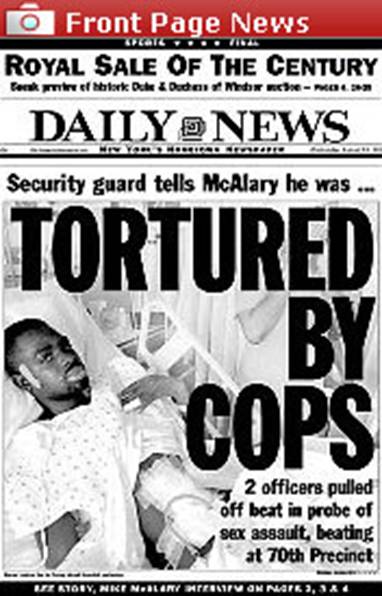
of the church with the Rev. Al Sharpton. It was McAlary's impassioned and exclusive
accounts of Louima's alleged torture in 1997 at the hands of cops in the 70th
precinct in "In some ways," said Mac,
"this had been my biggest cop story. Almost like homering in my last at
bat. It had changed the case, and it had changed the city somewhat. It had
changed me a little, too." At the time he wrote the Louima stories
he was dying of colon cancer of which
he said; "The Cancer life, I have discovered, is not unlike waking up on
death row. "Ordinarily, I'm not bitter or even
panicked. I'm fine so long as I don't obsess too much on the possibility of
never being a grandfather to my 12-year-old son's kid or missing my 10-year
old daughter's wedding or being unable to teach my 5-year old boy how to
throw a curveball." He finished writing his first
non-fiction book, "Sore Loser," and was hard at work on the second
book when he died. His friends are said to be working to complete that
book. I noticed a copy of "Sore
Loser," about a He pulled the book and opened it to show
me the salutation Mac had written for him at a party in Elaine's held shortly
before his death. It read: "For Gregory, my special
and gallant friend. "You have showed your humor and
intelligence across the years. Your friend, Mick McAlary." Lasak had been at the hospital just a
week before Mac's death. It was now a matter of time for the great reporter
who was surrounded by his family and friends. "He went into the shower and I said
goodbye to him and he waved goodbye to me," said Lasak who had presided
over some of the most sensational trials in I asked Lasak what was it that had drawn
McAlary to the cops and the cops to him. Cops, as former First Deputy Police
Commissioner John Timoney said, don't usually like reporters. "Most cops
look down on newspaper reporters," said Timoney, a tough cop from Lasak confirmed those remarks by Timoney
adding that "He had an aura about him. And he was trustworthy. He
wouldn't hurt you just for a story. Detectives took to him and they have to
rely on their instincts in their work. He was the kind of guy who looked you
in the eye and he never misled you." "He was brash and he was cocky but
under all that he was a sincere man who loved his work. Right up to the end
he was breaking our onions. He was being Mike." He was still being Mike when young
Newsday reporter Al Baker went to see him in the hospital a few days before
his death. Baker, who had worked with McAlary at
the Daily News, admired the columnist for his round-the-clock work ethic, and
for his smarts. "He was always saying to me,
'C'mon, let's go!" Baker recalls. "He had his computer hooked up to
the Internet and he said 'this makes you smarter.'" At the hospital, Baker was told by
Kriegel not to show emotion at Mac's bedside. "Mac reached his hand out
to me and said 'I love you' and then he whispered, 'Go, be great.'" Just being Mike. |
|